

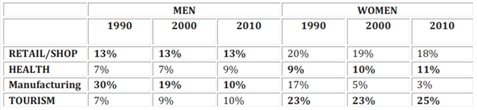
![[Writing Task 1 - Table] The table below shows the percentage of men and women working in different employment sectors in 1990, 2000 and 2010.](https://www.hrsviet.com/uploads/0000/1/2026/01/19/men-women-banner.jpg)
| Band 6.0-6.5 | Band 7.0 |
|
The table illustrates how the proportion of male and female workers in four sectors changed between 1990 and 2010. Overall, the percentages of females were higher than that of males across the board, except for manufacturing the only field bucking the trend. Concerning Retail/Shop employment, the proportion of male workers remained stable at 13% during 20 years, contrary to a slightly decreasing trend in female counterpart in same field, with number falling inconsiderably from 20% to 18%. When it comes to Health, the research documented a insignificant growth from 7% to 9% in male job-holders, bearing a resemblance to a steady growth from 9% to 11% in female workers working in health related jobs. Regarding males in manufacturing industry, most of them (30%) worked in this industry in 1990, but the figure decreased gradually in the following twenty years, approaching 10% in 2010, exactly one-third of itself at the beginning. A similar downward trend could be seen in the number of female workers in the same field, with figure going down to 3% in 2010, nearly one-eighth as much as it was at 17% in 1990. As for those working in Tourism, there was a climb from 7% to 10% in male workers, consistent with a similar rise from 23% to 25% in female counterparts. |
The table compares changes in the proportions of male and female workers across four employment sectors between 1990 and 2010. Overall, women accounted for a higher percentage of the workforce in most sectors throughout the period, with manufacturing being the only exception where men predominated. In general, employment in manufacturing declined sharply for both genders, whereas the remaining sectors experienced either stability or moderate growth. In the Retail/Shop sector, the proportion of male employees remained unchanged at 13% over the 20-year period. By contrast, the figure for female workers showed a slight decline, falling marginally from 20% in 1990 to 18% in 2010. Turning to Health, male employment rose modestly from 7% to 9%, mirroring a similar increase among females, whose participation grew steadily from 9% to 11% over the same timeframe. By contrast, Manufacturing witnessed a pronounced downward trend. In 1990, 30% of male workers were employed in this sector; however, this figure dropped dramatically to 10% by 2010. A comparable but more substantial decline was observed among female workers, whose share fell from 17% to just 3%, representing almost an eightfold reduction. Finally, employment in Tourism increased for both genders. The proportion of male workers rose from 7% to 10%, while the corresponding figure for females climbed slightly from 23% to 25%. |
|
❌ Hạn chế
|
✅✔ Task AchievementOverview rõ ràng, nêu 2 xu hướng chính. ✔ Coherence & Cohesion
✔ Lexical Resource
✔ Grammar
|